Care for All 2050

Inclusive Community Care Society 2050

1

Vision for a 2050-Model Community-based Integrated Care System

The Regional Community Care System (RCCS), developed with a 2025 target, must be deepened and evolved to address increasingly critical challenges — while upholding its founding principles. The goal is a "hyper-integrated" system that reduces over-reliance on acute-care hospitals and enables older adults with both medical and long-term care needs to receive continuous, individualized care within their familiar communities, preserving their dignity until the very end of life.

Rather than a one-size-fits-all national approach, flexible and diverse strategies are required — tailored to each region's demographic composition, medical and care resources, geographic conditions, and residents' values. The system must be truly comprehensive, encompassing prevention, housing, daily living support, and opportunities for social participation.

2

Strengthening Integrated Delivery of Medical Care, Nursing Care, Prevention, and Daily Living Support

There is an urgent need to transition from mere "coordination" to deeper "integration" of services — encompassing shared goal-setting, collaborative care planning, and seamless transitions between services. In particular, preventive care and health promotion programs should be placed at the core of the RCCS.

Leveraging community activity hubs (Kayoi-no-ba) to promote health-building activities and social participation is essential for extending healthy life expectancy (kenkou jumyou) and improving quality of life (QOL). Furthermore, support for the growing number of working caregivers (business carers) and attention to Social Determinants of Health (SDH) are indispensable elements of a truly life-encompassing RCCS.

ACTION LIST
01

Deepening and Evolution of the Community-based Integrated Care System

  • VisionHyper-integrated system — unified delivery of medical care, nursing care, prevention, housing, and daily living support
  • InfrastructureNational Health Information Platform; EHR/PHR utilization
  • CollaborationTransforming interprofessional collaboration into true team-based care models
02

Full-Scale Deployment of Technology

  • AIDiagnostic support, individualized care planning, risk prediction
  • IoTRemote monitoring, smart home technology, preventive intervention
  • RoboticsPhysical care assistance, surveillance, and communication support
  • AdvancedApplications of digital twin technology and XR (Extended Reality)
03

Transition to Personalized, Prevention-Centered Care

  • PersonalizationOptimized care leveraging genomic data and life-log (PHR)
  • Prevention-FirstExtending healthy life expectancy and maximizing QOL as top priorities
  • Nutritional SupportFood tech, precision nutrition, and 3D food printing
04

Workforce Development, Retention, and Work Style Reform

  • TrainingDigital literacy and AI utilization skills as mandatory competencies
  • EfficiencyPromoting technology-driven task shifting and task sharing
  • EnvironmentSalary improvements, workload reduction, and mental healthcare support
05

Institutional & Policy Innovation and Ethical/Social Infrastructure Development

  • ReimbursementRevision toward value-based care and technology adoption incentives
  • LegislationAmendment of the Next-Generation Medical Infrastructure Act; promotion of data utilization
  • Safety & EthicsRigorous privacy protection and cybersecurity measures
  • AI EthicsGuideline development; transparency, fairness, and human oversight
Short-term
~2030

Foundation Building Phase

Establishing the National Health Information Platform, launching pilot programs, and initiating workforce development

Mid-term
2031–2040

Full Implementation Phase

Full-scale technology deployment, advancement of task shifting, and transition to value-based reimbursement

Long-term
2041–2050

Maturation & Co-evolution Phase

Maturation of personalized, preventive, and predictive care; a system where humans and technology co-evolve

2025
Emotion Estimation × Education Support AI "EMOTIP"
Exhibition at the Osaka-Kansai Expo
: Initiatives to Improve Care Quality and Reduce Turnover Rates in Nursing Care Settings Using AI Video Analysis

Background

The nursing care industry is facing a chronic labor shortage. When we interviewed over 500 caregivers, the reasons for leaving within 3 years were "no prospects for the future" (15.4%) and "current salary" (14.9%), confirming that future uncertainty and working conditions are the leading causes of turnover.
In addition, difficulties in communicating with users who have trouble expressing emotions, such as dementia patients, were a major source of stress for both users and caregivers.

Challenge

A system is needed to correctly understand the emotions of care recipients and provide appropriate support, thereby reducing the stress of residents and the burden on care staff. Instead of traditional observation and record-based evaluations, there was a demand to visualize the quality of care and support self-evaluation of care skills, thereby reducing the burden of staff training and leading to a lower turnover rate.

Tasks

We exhibited at the "Future Life Experience" (July 8 - July 14) of the 2025 Osaka-Kansai Expo, and promoted a project to entrust the future visions envisioned by everyone to the "Tree of Future Shining with Life" and broadcast it to the world.


1. We developed a system that analyzes the emotional states and behavior patterns of users with high precision through video analysis using small far-infrared cameras and a proprietary Large Language Model (LLM).
2. We built a feedback function that numerically visualizes the quality of caregiver responses based on AI analysis results, and a safe monitoring function that shares daily life conditions and "how happily they are living" with their families.
2024
Predicting Clinical Trial Success of Immune Checkpoint Inhibitors
: AI Utilization for Efficient and Effective Drug Development

Background

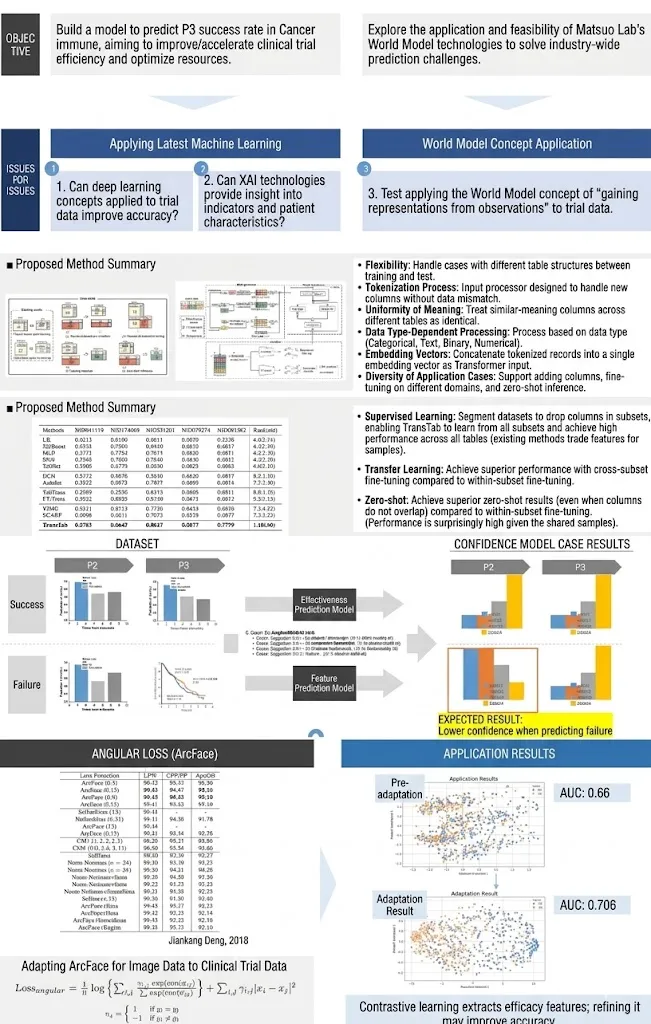
Drug development requires over ten years and costs hundreds of billions to trillions of yen, with success probabilities declining from 1 in 15,000 a decade ago to 1 in 30,000 today. In this context, optimizing and accelerating clinical trials and resource allocation has long been a challenge for the industry. Particularly, the transition success rate from Phase II to Phase III is only 24.6%, leaving room for significant improvement.

Challenges

We worked on predicting the success probability of Phase III clinical trials for immune checkpoint inhibitors. Applying the concept of "acquiring representations from observed information" of the world model, we visualized and verified the precision improvement using patient blood and vital data.

Tasks

Developed by a team.
1. Process of translating abstract concepts of immune environments into concrete content step by step.
2. Implementation of AI directly addressing social challenges through medical projects projected to change significantly in the next decade.

2024project

2023
Realizing Personal NFTs That Are Rentable but Non-Transferable
: Building a Transparent Data Management System for Medical Data Utilization

Background

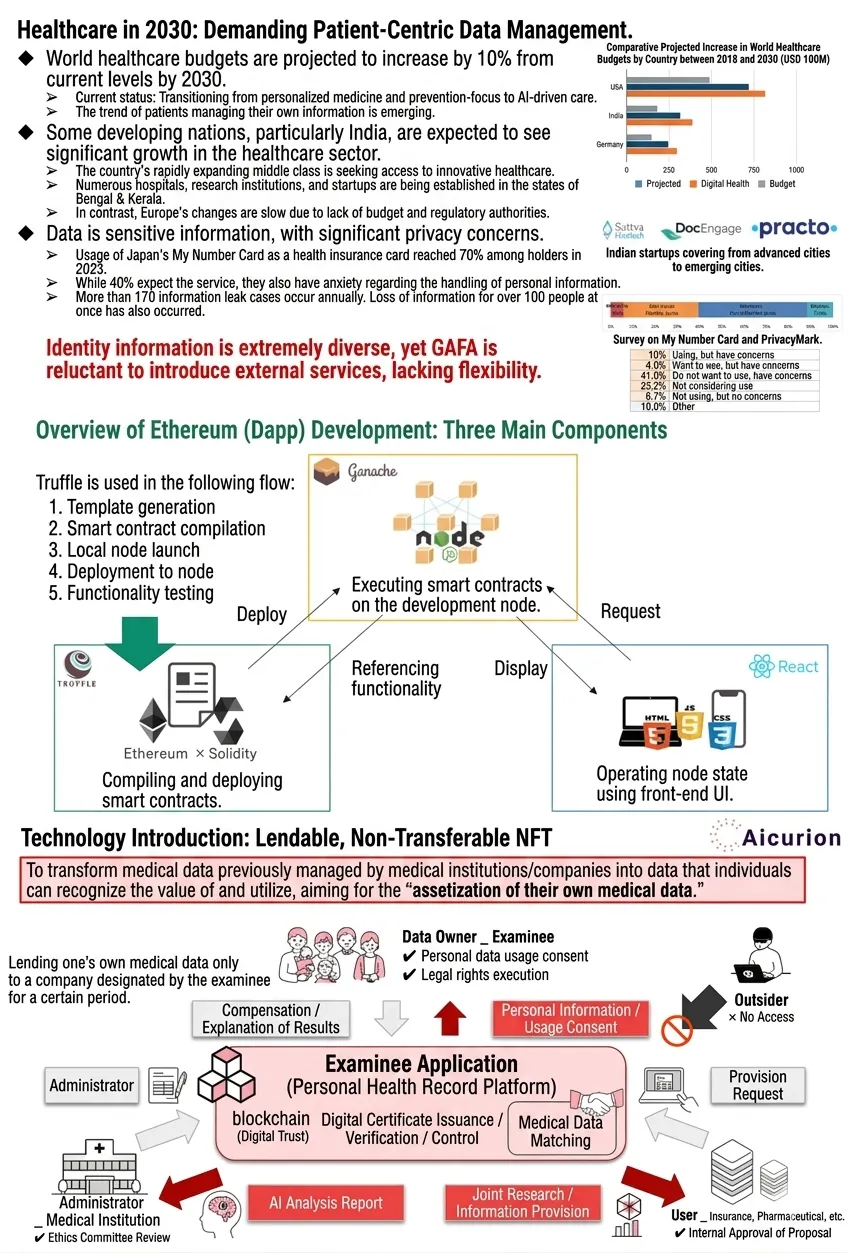
In the modern medical field, the utilization of data remains underdeveloped. I focused on transforming data managed by medical institutions into "data that individuals can recognize the value of and utilize." However, this concept necessitates the construction of mechanisms that ensure both security and transparency. To date, there have been no successful cases of such implementation, leaving numerous technical and operational challenges unresolved.

Challenges

While individuals providing health checkup data wish to limit items and the duration of data sharing, insurance companies require a system that ensures data accuracy while enabling its business utilization.

Tasks

Independently developed:
1. Integrated previously independent technologies of rentable NFTs and non-transferable NFTs to develop NFTs that meet diverse needs.
2. Built a VC issuance system using "Blockcerts" based on the Verifiable Credential Data Model specifications.
3. Designed and developed a system for transferring tokens from users to data holders through the rental of health checkup data.

2023project